Verified contacts
The contact is checked before a new lead reaches your reps.
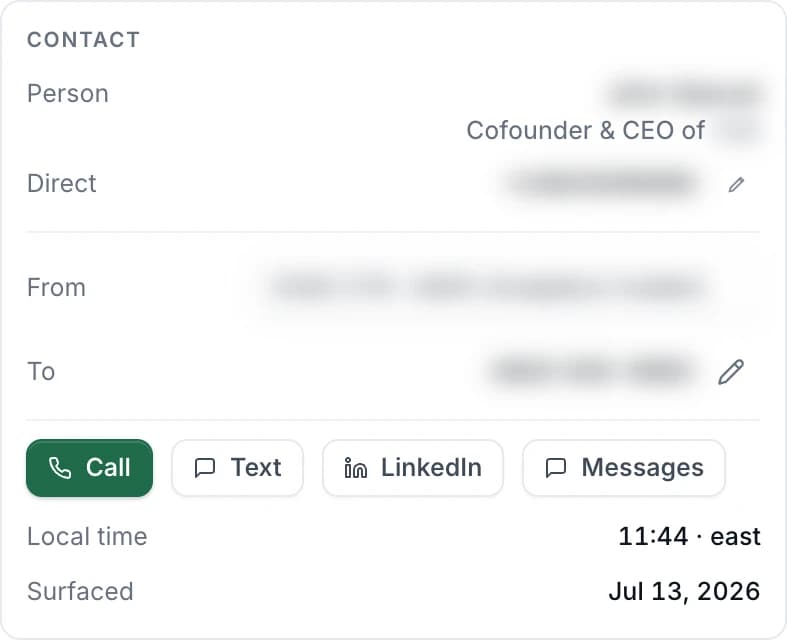
Before a new lead reaches your reps, it has to show a way to reach it. The lead card names the person when one is on file, labels the line, and drops a person's number once a rep logs it as wrong or bad.
Your reps make every contact. We never contact your prospects without your oversight and approval.
Ten free leads first. Nothing to sign until you decide.
Sound familiar?
Where bought contact lists let your reps down.
The direct line rings the front desk.
The list says direct. The rep gets a switchboard and a transfer that goes nowhere.
Placeholders pass as phone numbers.
N/A, a dash, a string of the same digit. The list still counts it as a contact.
Bad numbers come back.
A rep reports a dead number. The next data refresh writes it right back onto the record.
Nobody knows where the bad data came from.
Wrong numbers pile up, but no one can see which source keeps sending them.
A placeholder is not a contact. The product checks the contact before a new lead reaches your reps, labels the line they are about to dial, and keeps a person's bad number off the lead once a rep reports it.
How it works
Check, label, correct. Your reps see the result on the lead card.
Check.
Before a new lead reaches your reps, it has to pass a contact check. Normally that means two ways to reach it, and always a dialable phone. Placeholders never count as a phone.
Label.
The lead card tells the rep whether the number is a direct line or the company main line. The dial control repeats the label before the call.
Correct.
When a rep logs a call as a wrong or bad number, that person's number comes off the lead. Your team cannot call or text it again. A company main line is never blocked this way.
What makes the contact on a card worth a dial.
Each part is built into the lead cards your reps already work.
A new lead reaches your reps only with a way to reach it.
Before a new lead reaches a rep's queue, it has to pass a contact check. Normally that means two of three ways to reach it: a direct line, a company main line or an email. It always means at least one dialable phone number. A lead that fails is not shown to reps and is not thrown away. It stays in review until enrichment finds another way to reach it.
A lead that fails waits for better data instead of being thrown away.
What this covers
- Normally two ways to reach the lead, always a dialable phone
- N/A, dashes, fake 555 numbers, repeated digits and sequential runs never count
- A company switchboard is never counted as a person's direct line
- A locked placeholder email never counts as a way to reach the lead
The rep knows who to ask for and what kind of line it is.
The lead card carries the named person, title, email and LinkedIn link when they are on file, plus the company, website, headquarters and industry. It tells the rep whether the number is a direct line or the company main line, and the dial control repeats the label before the call. The product records where a lead's direct number came from and whether our data partner marked it valid. When a number is not marked valid, the dial control shows an unverified hint next to Call.
The rep sees what kind of line it is before the phone rings.
What this covers
- Named person, title, email and LinkedIn link, when on file
- Company, website, headquarters and industry
- Direct line or company main line, labeled on the card and the dial control
- An unverified hint when our data partner did not mark the number valid
A person's bad number comes off the lead and stays off.
When a rep logs a call as a wrong or bad number, that person's number comes off the lead. Your team cannot call or text it again, and a later data pass cannot put it back. A company main line is never blocked this way. The Analytics view breaks bad numbers down by where the number came from.
One report from a rep keeps that number off for your whole team.
What this covers
- Logged from the call outcome
- That person's number comes off the lead
- No call or text to that number again from your team
- Bad numbers broken down by source in Analytics
Pricing
Free cards first. Then a price in writing.
Nothing until your reps have dialed the free cards. Then one of three plans: run the platform yourself, have our team do the calling and book the meetings, or pay per booked meeting. Prices are on the pricing page, and we do not take payment before your reps have tested the platform.
Four things that stay true.
The product checks the contact. Your reps do the talking.
Your reps make every contact.
We never contact your prospects without your oversight and approval. Every call, text, email and LinkedIn message comes from your reps.
Part of the lead card.
The contact check, the line labels and the bad-number block are how the lead cards work, not a separate tool.
Ten free leads first.
Your reps grade every card before you decide.
Nothing to install.
One login opens the lead cards, Plan, Flow State and Analytics.
Guardrails at the dial.
The platform checks before your reps reach out.
A call to a lead marked do not call is refused at the moment of the call, on the server, not only on screen.
A call outside contact hours is refused until the window opens.
Texting needs a direct or mobile number. Texts never go to a company main line.
A contact who opted out cannot be texted again.
A lead also needs a reason before it reaches your reps: why this lead, an opening angle and the evidence behind them.
Reps can dial contacts in any country. Texting is for US numbers.
Straight answers.
Common questions from sales leaders.
See the cards. Then decide.
Tell us who your team sells to. We define your Ideal Customer Profile on the first call, build ten lead cards from it, and your reps grade every one before you decide.
Questions? Email [email protected]